Prosthetic bodies

Curator
Jana Stojaković
PROSTHETIC BODIES
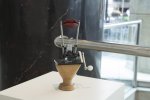
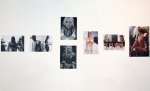
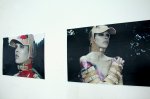
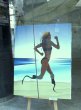
Topic of the show titled “Prosthetic bodies” is human body subjected to various, mostly cruel interventions, in order to satisfy imposed social models and gender roles. Body building, steroids, plastic (aesthetic) surgery, with diverse prosthetic implants are only one step from androids, cyborgs and robots…
Artists with various sensibilities, different generations and nationalities, gathered on this exhibition, are witnesses of the world which is not anymore modern, contemporary or even postmodern, but the world in which is not enough only to live and contemplate, but also simultaneously act, in it and through it – in this case, it is about engaged artistic practices, which are different from the previous, at the first place, in pushing “step forward” inside the boundaries that they shift.
Although, many of them are presented through classical forms/techniques of visual arts (drawing, painting, sculpture), there are also the others, who do that through photographs, videos or complex projects contained of many diverse components, elements and techniques…
Now, when the perspective of “post-physical”, “post-biological” civilization is opened, when philosophy takes the mission of value-meaningful preservation of body, pervading with physical all cells of its language and art, in the century after technological break-through, it comes with attitude in relation to the new criteria of plasticity and tactility of the ideas themselves.
Science about human body, as the highest organ of cosmic life and its changeable spiritual-cultural meanings becomes common subject of philosophy, physiology and art.
In contemporary world, where society leaves very few chances for individual to make crucial social decisions, at the same time, offering “possibility” of choice, tolerance, correctness and importance, the only “free space” for declaring personal attitudes and thoughts, seems to stay only body. While some of the artists presented on this exhibition question contemporary topics inspired by changes of cultural perspectives of body (like identity and gender etc.), others examine the relation of body and technology, modifications and transformations through plastic surgeries; disciplines, torturing, punishing body for the sake of modeling “the perfect” form…
Social construction of physical experience from long ago does not represent the speculation of cultural theoreticians, but our physical experience is influenced by scientific researches, as well as social discourse; new medical technologies, numerous propaganda messages, advertising, discussions about sexual behavior and practices, all that contribute in shaping thoughts, values and experiences of people. If we accept that physical characteristics (for example sex and gender) are not defined in advance, nor determined and static, but subjected to modification, and by that physical borders become permeable and they should be always again established, there is a possibility that this body is transformed by every move, every expression. Uniqueness of every single body, actually of physical subjectivity, commence as consequences of diverse joining: racially, class, inter-sexual and external connections.
Body, according to L. Franolić, occurs in a form of personal emotional need; it becomes “personality project”. Anatomy becomes subjected to change, redefinition, while socio-cultural production of body happens all the time, whether we are aware of that or not. The concept of “incomplete body”, as Franolić sees, is the only acceptable; development of biological and social sciences contribute to this standpoint, since body is permanently in the process of materialization, building and creating from something else, therefore it does not represent fact or something predefined and fixed, but rather modified by individual wills, social and external influences.
Contemporary science and technology, apart from giving again knowledge and insights of body, also influence ability of observation, transformation and manipulation – of physical functions as well as of physical concepts. By development of anatomy, and later, medical instruments by which is possible to see body interior, body becomes transparent; biotechnologies, together with those which enable visual penetration into body, transfer it into public space where, bare and supervised, completely gets exposed to public. Body becomes a collection of interconnected pieces, actually fragmented body.
New medical technologies of examination and manipulation of body are more present and in the focus of artistic researches. Some artists, as well as theoreticians, think that technology offers the possibility of more complex (even total) physical experience – by building instruments and devices which enable new sexual and sensitive experiences, and by that also rejecting standard definitions of gender and limitation of physical body.
Need for physical change is obvious in everyday life and practices of people; modification of body does not happen anymore only in laboratories for genetics, robotics and simulations but need for body “modernization” can be applied through excessive consumption of chemical accessories in order to regulate its “affective inconsistency with the world”. It is a fact that entirely healthy people take medicines, supplements and diverse accessories – to sleep, wake up, stay focused, energized, to upgrade productiveness, eliminate anxiety and stress. Body seems too weak to confront with requires of contemporary world and to stay in the flow of faster and more demanding system. Sexuality, intelligence, mood, strength and other body conditions are navigated and manipulated by pharmaceutical companies, through their products, and natural body boundaries slowly diminish and disappear.
Construction and deconstruction of our own bodies becomes everyday life; technologies contrive numberless physical transformations, while body itself converts into material for identity modification. Plastic and aesthetic surgery change shape and gender, hormones muscular mass, diets figure; the outcome is body similar to replaceable material which will embody subject, or “accept” chosen identity which is always possible to transform again.
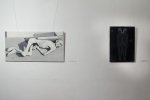
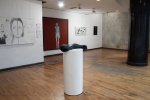
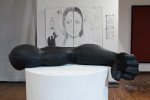
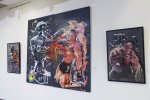
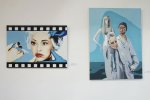
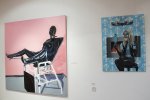
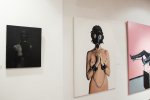
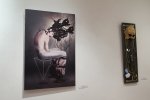
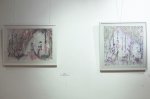
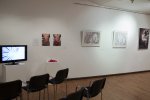
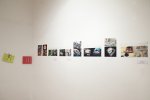
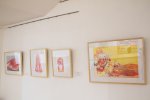
Tendencies of the new century art and contemporary artistic practices, which is followed by all twenty-three artists presented on this exhibition, show unusual state of body converted into an object. Whether they inquire sexual identity or physical restraints, physical endurance or sexuality, relationship between woman and men, pain and death, all works have body in their focus; it becomes the place of inscription, definition, redefinition and questioning the world. Here as well as on some famous works, the reason of art is not anymore seeking for beauty, but rather body inverse, touching the intestines, flesh (carne) itself, imposing of disgust and horror, playing with identity… Body can be disassembled, destroyed and used as material for fun, torture or fantasy; skin, muscles and organs, entirely separated from individual, are parts of the artworks, displayed here.
Prosthetic bodies remind us that bodies, as well as beauty, are never natural, but always subjected to fashion, addicted to historic and cultural context and created by force. They warn us to keep off the illusion that science and technology act outside our lives and our corporeality, that we cannot stop technologies interfering with our corporeality since technologies are those which generally enable our bodies to become sexual, racial, modern or rational. In our century, technologies cannot be separated from body anymore, as well as body cannot be isolated, observed and talked about independently of society and politics which are involved in every aesthetical and technological invention.
Milica Stojaković
Artists
- Brankica Končarević
- Igor Ajman
- Jana Stojaković
- Nikola Kolja Božović
- Marina Hoermanseder
- Marina Marković
- Milica Ružičić
- Nevena Prijić
- Predrag Damjanović
- Shikiko Aoyama
- Zoran Todorovic
- Vuk Vučković
- Davor Dukić
- Srdjan Marković Djile
- Dragana Grujičić
- Jarrod Sanderson
- Jelena Marković
- Katarina Carmignani
- Marcella and The Forget me Nots
- Merima Bakić
- Petar Mošić
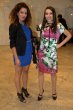
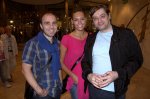
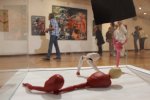
Photos from the exhibition